

Alcohol, Betting and Prohibition: How American Casinos and Speakeasies Survived the 1920s
American nightlife in the 1920s is often reduced to a familiar picture: jazz, hidden bars, bootleg liquor and gangsters guarding back-room tables. The reality was more complicated. National Prohibition, which took effect on 17 January 1920, restricted the manufacture, sale, transport, import and export of beverage alcohol, but it did not erase demand for drinking or for betting. It also did not create one uniform national gambling law. Gambling remained largely a state and local matter, which meant that a card room, bookmaker or roulette game could face very different legal risks from the speakeasy selling whisky in the same building. By the historical record available in 2026, the clearest way to understand the period is not to imagine modern legal casino resorts operating secretly, but to see a patchwork of illegal gambling rooms, private clubs, nightclubs, roadhouses, bookmakers and speakeasies that survived through concealment, customer loyalty, political protection, mobile supply chains and the simple fact that millions of Americans were still willing to pay for prohibited drink and unlawful betting.
Prohibition Changed the Economics of Drinking and Betting
The Eighteenth Amendment had been ratified in January 1919 and became effective a year later, on 17 January 1920. Its wording targeted the manufacture, sale and transportation of intoxicating liquor for beverage purposes, together with importation and exportation. Congress supplied the enforcement machinery through the National Prohibition Act, better known as the Volstead Act, which treated beverages containing more than 0.5 per cent alcohol as intoxicating for most purposes. The law was sweeping, but it was not as simple as a ban on every contact with alcohol. Drinking itself was not the central offence written into the Eighteenth Amendment, and legal exceptions remained for such uses as medicine and religious rites. Stocks lawfully held before Prohibition also complicated enforcement. These gaps mattered because they created legitimate-looking channels through which alcohol could sometimes be obtained, diverted or disguised, while illegal producers and smugglers supplied the much larger trade that grew around ordinary social drinking.
Demand quickly proved stronger than the law’s supporters had expected. The National Archives notes that alcohol consumption did fall during Prohibition, especially in the early years, yet illegal production and distribution became widespread and enforcement never came close to closing every route into the market. New York illustrates the scale of the problem. Estimates cited by the National Archives suggest that by 1925 the city alone had somewhere between 30,000 and 100,000 speakeasy clubs. Those establishments ranged from crude rooms serving questionable spirits to expensive nightclubs with live music, food, table service and carefully screened customers. The enormous gap between legal prohibition and actual behaviour changed the economics of nightlife. A product that had previously been sold openly now carried a scarcity premium, while the risk of seizure, arrest and theft increased costs. That combination created room for operators who could secure supplies, protect premises and attract a dependable clientele.
Betting followed a different legal map. There was no equivalent of the Eighteenth Amendment banning gambling throughout the United States, so operators had to navigate state statutes, municipal rules and local enforcement. This distinction matters especially when discussing “casinos” in the 1920s. Nevada, later synonymous with legal casino gambling, had prohibited major forms of gaming before the decade began; state research records that gambling was illegal there from 1913 until legalisation in 1931, although enforcement was uneven and illegal games continued in a number of communities. The large, licensed casino resort familiar from later American history therefore did not define the 1920s. In many cities, what contemporaries might call a gambling house was a private room, club or back-room operation offering cards, dice, roulette or bookmaking. Some operated beside illegal bars, but the liquor offence and the gambling offence were legally separate problems, even when the same owner or criminal group profited from both.
What a 1920s American “Casino” Really Was
The word “casino” can mislead modern readers because it suggests a purpose-built property with licensed tables, audited games, security staff and a formal regulator. In the 1920s, illegal gambling businesses were usually smaller, less stable and far more dependent on local conditions. A city gambling room might occupy an upstairs suite, a basement behind a restaurant, rooms above a saloon that had become a speakeasy, or a private club where admission depended on an introduction. The games themselves were familiar. Contemporary anti-gambling laws listed roulette, craps, twenty-one, poker, keno and other banking or percentage games, while bookmakers took wagers on horse racing and other contests. Equipment could often be moved or hidden quickly, and some establishments kept the public-facing part of the business separate from the room where money changed hands. That flexibility made closure inconvenient but not always fatal: operators could relocate, reopen under another name or move the gambling side of the business to another address.
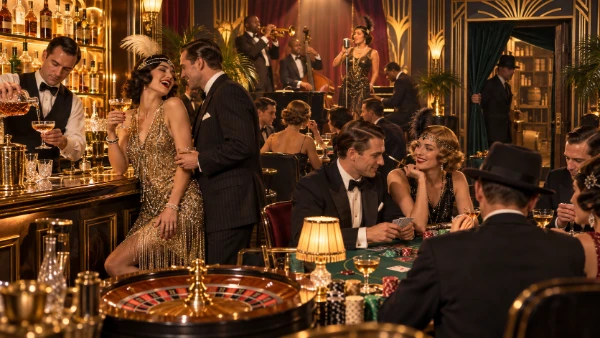
Alcohol, betting and entertainment worked well together because each could keep customers on the premises longer. A speakeasy that offered only drinks competed largely on liquor quality, price and privacy. A club with music, dancing, food and gambling could earn from several activities during the same evening and give patrons more reasons to return. Harlem’s Cotton Club shows how complicated such establishments could be. It became one of the best-known nightclubs of the era, featuring major African American performers while enforcing a racially discriminatory policy that admitted white audiences. Duke Ellington’s orchestra became the house band in 1927. A surviving Cotton Club bottle tag held by the Smithsonian dates from 1923–1933 and told guests that the bottle’s contents were sold as a beverage and were not to be mixed with alcoholic liquor in violation of Prohibition law. The wording is a small but revealing piece of evidence: nightlife businesses could maintain a formal appearance of compliance even while operating in a social environment strongly associated with illegal drinking.
Atlantic City offers another useful example because it was a major resort long before legal casino gambling arrived there in 1978. Rutgers University’s chronology of the city records that weak local enforcement after the Volstead Act helped illegal alcohol sales expand and cites an estimate that, between 1926 and 1933, about 40 per cent of illegal alcohol entering the United States came ashore in or near Atlantic City. Political boss Enoch “Nucky” Johnson became closely associated with a local system in which vice, tourism, political influence and protection overlapped. That did not make 1920s Atlantic City a legal casino centre. It was instead a resort where illegal liquor, bookmaking and other forms of vice could benefit from a permissive local climate. The distinction is important: the survival of gambling businesses during Prohibition was often less about defeating a single national law than about operating in places where local authorities lacked the will, resources or political incentive to suppress every offence consistently.
How Speakeasies and Gambling Rooms Stayed in Business
The first line of defence was control over access. Speakeasies became associated with passwords, peepholes, doormen and membership cards because an illegal bar could not safely admit everyone who knocked. Screening customers reduced the chance that an unfamiliar visitor was a Prohibition agent, police officer or rival. Gambling rooms had the same incentive to limit entry, particularly when a raid could lead to the seizure of cash and equipment. Premises were often arranged to buy time: a public restaurant or club area might sit in front of a less visible drinking or gambling room, while staff could warn one another when police appeared. The popular image of every speakeasy having elaborate secret doors is exaggerated, but concealment was real. Surviving records and photographs show repeated raids, hidden stores and improvised methods for keeping evidence out of sight. Security was therefore not a decorative feature of the era; it was an operating expense, as necessary to some proprietors as rent, staff or stock.
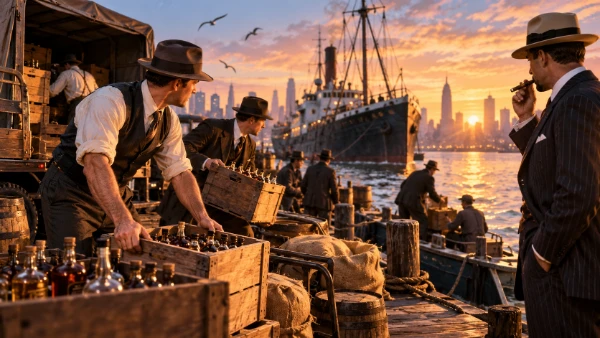
The second requirement was a reliable liquor supply. Smuggling became a specialised business with its own routes, crews, warehouses and wholesalers. The U.S. Coast Guard records that by 1922 hundreds of “mother ships” were operating off American shores in areas known collectively as Rum Row, with vessels waiting beyond the reach that smugglers believed federal authorities could easily exercise and smaller boats carrying cargo to shore. The Coast Guard expanded its cutters, patrol boats, intelligence work and eventually aviation in response, yet the trade adapted by moving farther offshore and changing methods. Imported liquor was only one source. Illegal breweries and distilleries operated inside the country, homemade alcohol circulated, and legal channels for medicinal or sacramental liquor could be abused. For a successful speakeasy, the crucial advantage was not simply finding alcohol once; it was maintaining enough stock, of sufficiently predictable quality, to serve customers night after night despite seizures and disrupted routes.
The third requirement was protection from people as well as from the law. Organised criminal groups could provide transport, enforcement, credit and access to officials, but those services came with coercion and violence. The FBI’s history of Al Capone describes how Chicago gangs treated illegal brewing, distilling and liquor distribution as major growth businesses after Prohibition began, while also maintaining interests in gambling and other rackets. Corruption was not uniform across the country, and not every speakeasy was owned by a national syndicate. Many were independent or semi-independent businesses buying from illegal wholesalers. Even so, bribery and political influence could determine which premises were raided frequently, which reopened after a closure and which were allowed to operate with little interruption. This helps explain why enforcement looked so different from one city to another. A federal law could be national, but the practical risks faced by a bartender, bookmaker or club owner were shaped heavily by local police, prosecutors, judges, political machines and public attitudes.
Supply, Security and the Price of Protection
As the illegal liquor trade matured, it increasingly resembled a supply network rather than a collection of isolated bootleggers. Importers or producers needed transporters; transporters needed storage; wholesalers needed trusted customers; speakeasies needed regular deliveries; and everyone handling valuable contraband had to consider theft. The same logic applied to gambling. A bookmaker required information, runners and a system for settling accounts, while a gambling room needed dealers, cashiers and someone capable of dealing with disputes. Criminal groups that could coordinate several parts of these chains gained an advantage because they reduced the number of weak links. Prohibition did not invent organised crime in the United States, and gambling rackets existed before 1920, but the liquor ban created a vast new market with unusually high margins. Profits from alcohol could finance expansion into gambling, protection and other illegal businesses, while an existing gambling organisation could use its contacts and cash handling experience to enter bootlegging.
Customers also carried part of the risk. Illegal alcohol had no ordinary retail guarantee, so quality could vary from imported branded spirits to badly made or adulterated liquor. Prices reflected not only the drink itself but the cost of smuggling, bribes, losses and scarcity. Betting had a similar trust problem. In a legal modern casino, rules, payouts and disputes are subject to licensing systems; an illegal 1920s gambling room depended much more heavily on reputation and the balance of power between operator and customer. A club that refused to honour wins could lose valuable patrons, yet a player had little formal protection if a game was dishonest or a bookmaker disappeared. This encouraged a peculiar form of private governance: personal introductions, known proprietors, house reputation and social networks became substitutes for legal consumer protection. For wealthier patrons, exclusivity could even increase a club’s appeal, but that exclusivity also helped operators identify strangers and keep the business within a circle that was easier to monitor.
Raids remained a constant hazard and reveal why survival should not be confused with immunity. A Library of Congress photograph from January 1929 shows Charles Vaglia inspecting damage to his Greenwich Village club after a police raid, a reminder that an illegal business could be disrupted suddenly even in a city crowded with speakeasies. Owners responded in several ways: keeping only limited stock on site, hiding bottles away from the main room, arranging rapid disposal of evidence, shifting activities between addresses and reopening after enforcement attention moved elsewhere. The famous ‘21’ Club later refined these techniques after opening at 21 West 52nd Street on 1 January 1930, using camouflaged doors, concealed storage and mechanisms designed to move or destroy liquor during a raid. Its best-known security system belongs technically to the opening months of the new decade, but it grew directly from methods developed by the same operators through earlier Prohibition-era businesses and shows how sophisticated evasion had become by the end of the 1920s.
Crime, Culture and the End of the Dry Decade
The most enduring effect of combining a large illegal alcohol market with existing gambling and vice networks was financial. Criminal organisations already involved in bookmaking, prostitution, theft or protection could add bootlegging to their income, while liquor specialists could use profits to buy political influence and muscle. In Chicago, Johnny Torrio and Al Capone became the most famous examples. Capone arrived around 1920, rose within Torrio’s organisation and took control in 1925. Competition for territory and revenue became violent, culminating symbolically in the St Valentine’s Day Massacre of 14 February 1929, when seven members or associates of the Bugs Moran organisation were killed. The massacre was widely attributed to Capone’s side, although he was in Florida at the time. It is too simple to say Prohibition created gang violence from nothing; the more accurate point is that illegal liquor supplied enormous new profits that intensified competition among organisations already willing to use bribery and force.
At the same time, speakeasies became cultural spaces whose importance cannot be measured only by arrest records. Jazz, dancing, fashion and changing social habits became closely connected with urban nightlife, particularly in New York and Chicago. Harlem clubs placed African American musicians before large audiences and helped make jazz central to the sound of the decade, yet the economics of that nightlife were entangled with racial inequality. The Cotton Club could employ celebrated Black performers while excluding Black patrons, turning African American artistry into entertainment for a white clientele. This contradiction matters because romantic accounts of Prohibition often treat the speakeasy as a uniformly liberated space. Some clubs did loosen older social conventions and bring new groups of customers into nightlife, but access still reflected wealth, race, neighbourhood, connections and the judgement of owners or doormen. The glamour was real for some patrons, while exclusion and criminal control were equally real parts of the same system.
By the end of the decade, the enforcement problem had become impossible to dismiss. Congress moved Prohibition enforcement to the Department of Justice in 1927, creating a separate Bureau of Prohibition, yet federal authorities still faced a market supported by persistent demand and protected in some places by corruption or public indifference. In 1929 President Herbert Hoover established the National Commission on Law Observance and Enforcement, commonly called the Wickersham Commission, to investigate law enforcement problems, with Prohibition as a central concern. Its 1931 report documented serious enforcement difficulties and helped strengthen the repeal movement. The economic crisis after the 1929 stock market crash added another argument: legal alcohol could restore tax revenue and legitimate employment at a time when both were badly needed. By then the argument over Prohibition was no longer only about drinking; it had become an argument about crime, federal power, local compliance, public respect for law and the practical cost of trying to suppress a mass consumer market.
What Prohibition Left Behind for American Nightlife and Gambling
The repeal of national Prohibition on 5 December 1933 did not simply return the United States to the legal order of 1919. The Twenty-First Amendment repealed the Eighteenth and restored a major role for the states in controlling alcohol. Speakeasies no longer needed to exist solely because ordinary liquor sales were forbidden, and legitimate bars, restaurants and clubs could again sell alcohol under new state and local rules. Organised crime, however, did not disappear with the liquor ban. Groups that had accumulated money, contacts and experience through bootlegging had incentives to shift attention towards gambling, labour racketeering and other businesses. The institutional lesson was also clear: banning a product with broad consumer demand had created enforcement costs and a lucrative illegal market. That lesson became one of the lasting reasons Prohibition is still studied as a case in the unintended effects of regulation.
Gambling followed its own timetable. Nevada legalised wide-open gaming on 19 March 1931, more than two years before national Prohibition ended. The law required licences for specified games and machines, marking the beginning of the state’s modern era of legal gaming. This chronology is important because it separates two developments that are often blended together in popular memory. The 1920s speakeasy did not gradually become the Las Vegas casino simply because alcohol returned. Nevada’s legal framework changed first, and the large resort casino developed later through tourism, investment, regulation and post-war growth. Atlantic City’s path was later still: New Jersey voters approved casino gambling there in 1976, and the first legal Atlantic City casino opened in May 1978. The famous resort city of the Prohibition years and the regulated casino centre of the late twentieth century occupied the same streets, but they belonged to very different legal systems.
Seen from 2026, the strongest evidence from government archives, museum collections and surviving contemporary material points to a practical explanation for how illegal drinking and betting businesses endured through the 1920s. They survived because demand remained high, the law treated alcohol and gambling through different jurisdictions, enforcement resources were limited, supply networks adapted quickly and some local political systems tolerated or protected vice. Operators reduced risk with screened entry, hidden stock, flexible premises and trusted relationships, while larger criminal groups used money and violence to secure territory and distribution. Yet survival came with costs: raids, unsafe products, corruption, extortion, violent competition and little protection for customers. The decade’s nightlife was therefore neither a simple story of glamorous rebellion nor a story of complete legal failure. It was a prolonged contest between prohibition, commerce and human behaviour, and it reshaped the way Americans thought about alcohol regulation, organised crime, gambling and the limits of enforcement.